


1 AgriPV.org
2 ISE Fraunhofer
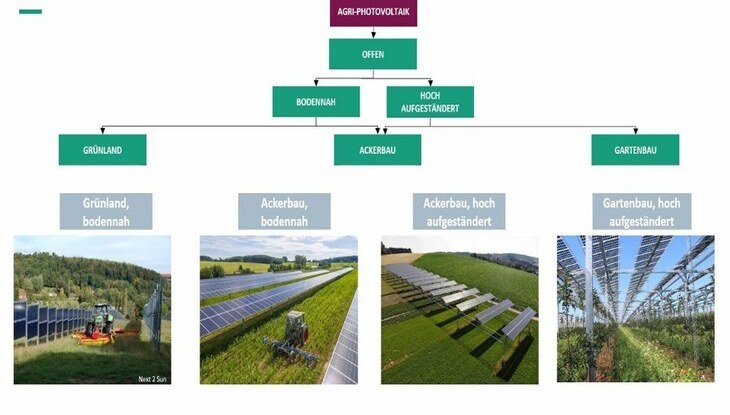
Category 1 systems have a structural height greater than 2.3 m

Category 2 systems are lower than 2.3 m

Planning and financing Agri-PV – ARCHEA AgriPV Planer
What defines Agri-PV
Agrivoltaics combines agricultural use with electricity generation on the same land. The key requirement is that substantial agricultural use is maintained – a few sheep grazing to manage vegetation do not turn a solar farm into an AgriPV system. Whether the combination is worthwhile depends on the crop, location, system design and grid connection. The key points at a glance:
System types
There are four basic types: elevated systems (modules above the cultivated area, approximately four to six metres high – for arable farming, fruit and speciality crops), vertical systems (upright, usually bifacial modules arranged in rows – with grassland or arable farming between them), tracking systems (movable modules, close to the ground or elevated) and crop canopies (modules forming part of a protective structure for fruit, berries and vines). The actual machinery heights and working widths required are always the determining factors.
Effects on plants and soil
Modules alter the microclimate: less direct sunlight can reduce heat stress, but can also limit photosynthesis and yields; soils heat up less, shade reduces evaporation, and suitable structures protect against hail or strong sunlight. The central research finding is that shade does not benefit every crop or help every year – it offers advantages in hot, dry years, while yield losses may outweigh the benefits in years with low light levels.
Findings from research
In the Heggelbach research project at Lake Constance, yields beneath the system during the hot year of 2018 were around 3 % higher for winter wheat and around 11 % higher for potatoes than on the comparison plot – in another trial year, however, potato yields were around 20 % lower. The frequently cited land-use efficiency of 160 % must also be interpreted with care: it is the sum of two relative yields (for example, 80 % agricultural yield plus 80 % electricity yield compared with separate use) and means neither 60 % more harvest nor 60 % more profit.
Electricity yield and economic viability
There is no universal electricity yield per hectare – the determining factors are installed capacity, row spacing, orientation and location. Annual yield is calculated by multiplying installed capacity by specific yield (example: 500 kWp × 1,000 kWh/kWp = 500,000 kWh). Fraunhofer gives indicative levelised costs of electricity of around 7–12 euro cents/kWh – this is not a guarantee of returns. A proven planning principle, which this planner also follows, is to calculate agriculture, the electricity generation system and the combined overall result separately – this reveals whether the combination creates added economic value.
Approval and financial support
Three separate assessments must be distinguished – a positive outcome in one does not replace the others: planning law (Section 35(1), No. 9 BauGB grants privileged status to certain special solar installations outside built-up areas – a maximum footprint of 2.5 hectares, only one installation per farmstead, and a spatial and functional connection with the farm), EEG support (AgriPV may qualify as a “special solar installation”, subject to Federal Network Agency requirements depending on the type of land) and agricultural support (Section 12 GAPDZV: 85 % of the area remains eligible if the usable agricultural area is reduced by no more than 15 %). The central technical reference is DIN SPEC 91434 – a maximum land loss of 10 % for elevated systems or 15 % for systems close to the ground, and at least 66 % of the reference yield; DIN SPEC 91492 adds requirements for livestock farming.
DIN SPEC 91434 – agriculture as the primary use
DIN SPEC 91434 (2021-05) is the principal technical specification for AgriPV systems where agriculture is the primary use. It classifies systems into categories: elevated systems (Category 1, clearance height above 2.10 metres) and systems close to the ground (Category 2, up to 2.10 metres); separate variants exist for grassland used for grazing (1D/2D). The core requirements for the agricultural land-use plan are: a maximum land loss of 10 % for elevated systems and 15 % for systems close to the ground, continued accessibility of the land for cultivation, verified light availability and uniformity as well as water availability, prevention of soil erosion, installation and dismantling without leaving residues, and a transparent calculation of economic viability. The agricultural yield must reach at least 66 % of the reference yield from the comparison plot; yield reduction and land-use efficiency are documented. Annex A of the specification contains the form for the agricultural land-use plan.
DIN SPEC 91492 – livestock farming
DIN SPEC 91492 (2024-06) supplements 91434 with livestock-specific requirements – for grassland used for grazing and all other areas relevant to livestock farming. In addition to animal welfare and livestock protection, the reverse aspect is also assessed: protecting the system against damage caused by livestock. Further criteria include adapting the system to the relevant husbandry method and animal species, pasture stocking density, light intensity and distribution beneath the system, water availability and rainwater distribution, effects on the microclimate, installation and dismantling that minimise soil disturbance, and evidence of commercial agricultural use based on a reference area and reference value. Measurement indicators are specified for quality checks during operation.
Operating models
Four approaches are common: owner operation (the farm invests and receives the electricity revenue), leasing (an operator uses the land, with farming activities and responsibilities governed by contract), a joint project company (the farm and an energy company share the investment and financial results) and cooperative participation. In partnerships, farming rights, liability for damage and yield losses, access, contract duration and dismantling must be clearly defined – the model determines who bears the risks and who benefits from the electricity.
Financing
Rentenbank explicitly finances agrivoltaics through its “LR-Förderkredite für Energieunternehmen”: construction and modernisation in accordance with DIN SPEC 91434 or 91492, up to 100 % of eligible investment costs, terms of 10, 15, 20 or 30 years and, depending on the option, one to three years without capital repayments. KfW 270 “Erneuerbare Energien – Standard” and programmes offered by regional development institutions may also be suitable – each with its own conditions and application process. Before placing an order or starting construction, please clarify which loans and grants are actually available – retrospective approval is generally not possible.
From an idea to a project ready for assessment
A proven sequence: record the details of the land and farm (location, size, ownership, soil, crops, machinery), clarify grid connection requirements early (feasibility, distance, costs, timescale), discuss the approval process with the local authority and building control authority in advance, develop an agricultural plan (crop rotation, working practices, light and water requirements), compare suitable systems using the same assumptions, test economic viability under adverse conditions (lower electricity revenue, higher connection costs, reduced crop yields, delays), and establish the contracts and supporting documentation required. We support you in this process: investment, operation & revenue, financing and liquidity calculated over the project lifetime – with freely adjustable assumptions.
Agri-PV with battery storage
A proven sequence based on real projects: request grid export capacity and additional import capacity from the grid operator early (confirmation can sometimes take months), make the grid connection substation storage-ready from the outset (allow space for metering), add storage to the planning application in good time (noise protection, fire safety documentation, soil protection, containment measures to protect water bodies, and the location and size of the substation), and define the metering arrangement and electricity marketing model before commissioning. Those who only plan storage retrospectively often pay twice – for modifications to the substation and for a second approval process.