


Jesús María, Argentina, 29 August 2017
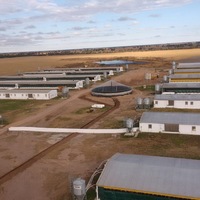
The medium-sized company from Hessisch-Oldendorf is building a 250kW biogas plant for the agricultural cooperative “Sociedad Rural de Jesus Maria”. The client and future operator is an association founded in 1946, consisting mainly of smaller farmers in a well-known agricultural region approximately 50 km north of Cordoba, a city of over a million inhabitants in the heart of Argentina.
The area around Jesús Maria is known for its wine and salami specialities. Historically, the town developed from an estate founded by Spanish settlers that produced the famous Lagrimilla, the first wine from the Americas to be tasted by the royal household in Madrid. The buildings are now part of a UNESCO World Heritage Site. After being connected to the railway network in 1873, Jesús Maria gradually began to develop into a small town, which today has a population of 40,000 in its conurbation with Colonia Caroya and Sinsacate.
The economy is strongly shaped by agriculture, livestock farming and food production.
Livestock farming in this area also causes environmental problems through the organic waste it generates. This is where ARCHEA comes in, providing a waste treatment solution based on closed production cycles that also supplies decentralised energy to the businesses of “Sociedad Rural de Jesus Maria”. The large quantities of pig and cattle slurry and slaughterhouse waste generated are digested efficiently by ARCHEA's innovative system, achieving a high gas yield that can then be used to generate electricity in a combined heat and power unit.
Oliver Nacke, Managing Director of ARCHEA, emphasised the good working relationship with Luiz Picat, the cooperative's director, and his team.
The high level of expertise is thanks to the ongoing efforts of “Sociedad Rural de Jesus Maria” to provide training and further professional development for its employees and members.
With its new project in Argentina, ARCHEA once again underlines the company's commitment to sustainability: on the one hand, solving local environmental and waste management problems while creating decentralised energy supply options, with the aim of establishing renewable power plants without government subsidies wherever possible, whose output is used directly by local businesses and residents.
On the other hand, involving local partners directly and generating a large proportion of the added value locally.
The groundbreaking ceremony and official presentation of the project took place during Expo Rural 2016. Oliver Nacke is confident that the plant can be commissioned next year as planned, as he can rely on his well-established team of employees, who have already demonstrated their skills and commitment under difficult conditions, most recently in India.