


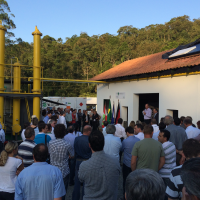
Pomerode, Brazil, 15 September 2014
Oliver Nacke, Managing Director of ARCHEA Biogastechnologie GmbH from Hess. Oldendorf: ‘A special day for me. Four years of development work and more than 20 trips to Brazil were rewarded today. The overall concept is unique. Pig slurry, previously stored in open earthen lagoons, is converted into natural gas at the biogas plant using pressurised water scrubbing, and into solid fertiliser using a drying system and aerobic post-composting. The fertiliser is marketed directly by the plant. Demand is very high, as Brazil does not have “topsoil” like we do in Germany. Once trial operation has been completed and full capacity reached, output will be increased to 1 million m³ of natural gas, which will be marketed as fuel at filling stations by Santa Catarina’s gas supplier SCGAS from Florianopolis. Transport will be carried out using existing tanker vehicles, as there is no natural gas network. The natural gas from Pomerode replaces gas previously supplied from Bolivia, the price of which has risen very sharply in recent years. Brazil obtains 80% of its natural gas requirements from Bolivia. Yet it could meet its own needs with biogas/natural gas from waste and become independent.
Biogaspark Deutschland GmbH from Bückeburg has made a substantial investment in the plant. Biogaspark Deutschland currently operates 24 biogas plants in Germany and will continue its involvement in Brazil.
Hans Prayon, Chairman of the Supervisory Board of the German-Brazilian Eco Conceitos S.A. group:
‘This plant is intended to serve as an example beyond Santa Catarina. Although Brazil already has hundreds of simple tunnel-model biogas plants, very few of them operate reliably over an extended period. With this differently designed plant, we want to demonstrate that this is feasible. Natural resources are the basis for producing gas, electricity and organic fertiliser. Essentially, the latest technology helps us find our way back to nature.’ The Eco Conceitos S.A. group, based in Pomerode, includes Archea do Brasil Ltda. as its technology partner and BiogasPomerode Ltda. as the operator. Cooperation partners on the German side are MVV decon GmbH (Mannheim) and Wirtschafts- und WissenschaftsZentrum Brasilien-Deutschland e.V. (WWZ – BD), based in Berlin. The privately financed plant is part of a project supported by the German Federal Ministry for the Environment and Deutsche Investitions- und Entwicklungsgesellschaft mbH (DEG).
Economically viable solutions to environmental problems
Hans-Dieter Beuthan, Executive Vice-President of WWZ – BD e.V., sees the project in Pomerode as an industrial demonstration plant. ‘Santa Catarina is Brazil’s largest pig producer, and pig slurry is one of the country’s biggest environmental problems. In Pomerode, we are demonstrating that there are also economically viable solutions to this problem.’ WWZ – BD commissioned an economic viability analysis, assisted with the approval procedures and supported the transfer of technology. Hans-Dieter Beuthan: ‘In the process, we found that Brazil already has modern environmental legislation. The main area where progress is needed is implementation at municipal level. It therefore comes as no surprise to us that interest in our plant is already exceptionally high, even before its official launch.’
Great potential for biogas in Brazil
To date, biogas has been used to generate electricity in Brazil in only a few pilot projects – primarily at landfill sites. According to the Brazilian electricity regulatory authority ANEEL, biogas currently accounts for just 0.06 per cent of the electricity generated. The German-Brazilian Chamber of Industry and Commerce in São Paulo considers that the 2010 legislation on waste treatment offers great potential for biogas. The National Solid Waste Plan (PNRS), for example, stipulates that municipalities must close all open dumps by the end of 2014 and treat, recover or dispose of all waste in suitable landfill sites. Materials from which energy can be recovered economically should be used accordingly. However, fewer than half of all municipalities currently have such facilities, creating enormous potential for new projects involving biogas production. Brazil’s biogas potential from wastewater and organic waste is estimated at around 50 million cubic metres of methane per day, or approximately 3,400 megawatts of untapped capacity.